
26 July 2026
SMS Notification Software: 7 Benefits for Repair Shops

Repair shops do not need more messages. They need better-timed messages that reduce chasing, speed up approvals and make collection easier. That is where SMS notification software earns its place.
TL;DR: Summary
- SMS notification software is most useful for repair shops when it automates status updates and reminders inside the repair workflow, not when it is treated as a separate marketing tool.
- SMS is strong for time-sensitive repair communication because industry sources cite open rates around 98%, and a 2016 PubMed systematic review found appointment attendance improved with SMS reminders versus no reminder, with a pooled odds ratio of 1.62.
- The best repair-shop SMS setup sends messages at drop-off, diagnosis, approval request, parts arrival, ready-for-collection and reminder stages, with clear consent and reply handling.
- SMS works better than email for urgent updates, but WhatsApp can be better for photos or longer conversations. Many shops benefit from using SMS for universal reach and WhatsApp for richer support.
- Choose software that connects SMS to repair tickets, IMEI or stock records, technician updates, reporting and multi-location workflows, so staff are not copying data between tools.
A good SMS workflow also improves transparency. When customers know whether a device is booked in, awaiting approval or ready to collect, staff spend less time repeating the same answer and more time moving jobs forward.
What is SMS notification software for repair shops?
SMS notification software is a business texting layer inside repair systems such as ePOS4Mobiles or Twilio-based tools. It sends automated messages at drop-off, diagnosis, approval, parts arrival and collection, so customers get timely updates without staff making manual calls.
In repair operations, this usually sits within repair ticket management. A message is triggered when the job status changes, when a technician adds a note, or when an appointment or collection window needs confirming. That matters more than “bulk SMS” because repair shops run on event-based communication, not generic campaigns.

A common misconception is that SMS software is mainly a marketing add-on. In practice, the strongest use case is transactional messaging tied to the live job record. If the text sits outside the repair platform, staff often have to re-enter phone numbers, statuses or collection notes, which creates avoidable errors.
"ePOS4Mobiles supports repair ticket management with repair status tracking, parts used, technician assignments, customer notifications and repair history."
Why does SMS work better than missed calls or email for repair updates?
SMS is usually seen faster than email, and GSMA and Twilio both cite open rates around 98%. For repair shops, speed matters because approvals, parts decisions and collection reminders often need action on the same day.
A missed call tells the customer nothing. An email may contain more detail, but many people will not see it quickly enough when a repair decision is holding up bench time. SMS sits in the middle: short, direct and hard to ignore.
There is also strong evidence on reminder behaviour. A 2016 systematic review indexed by PubMed looked at 28 studies, including 13 randomised controlled trials, and found that SMS reminders improved appointment attendance versus no reminder, with a pooled odds ratio of 1.62. Half of the studies sent reminders within 48 hours of the appointment. The review did not find major subgroup differences by timing, age, setting or specialty.
That does not mean every text will generate a reply. High open rates are not the same as high response rates. The practical lesson is simple: use SMS for actions that need quick acknowledgement, and use longer channels only when the customer needs explanation, images or a detailed estimate.
What are the 7 main benefits of SMS notification software for repair shops?
SMS notification software gives repair shops faster customer response, lower call handling and clearer repair visibility. In a repair environment, the real gain is operational: fewer stalled jobs and fewer avoidable collection delays.
-
Fewer no-shows and missed appointments
Reminder texts improve attendance in many settings. If your shop books diagnostics, screen replacements or trade-in appointments, a simple reminder can protect technician time. -
Faster approval for quoted work
When a technician finds extra damage or a part upgrade option, an SMS prompt can speed up the yes or no decision that keeps the job moving. -
Lower inbound call volume
Customers call less often when they already know the current stage. That is valuable at busy counters where staff are handling walk-ins, repairs and stock checks at once. -
Clearer customer trust
Status messages create visible progress. “Booked in”, “awaiting part” and “ready to collect” each reduce uncertainty in a way that generic promises do not. -
Better collection rates
Devices that sit uncollected tie up shelf space and cash flow. Collection reminders help convert completed jobs into completed sales. -
Improved staff handover
When updates are triggered from the ticket, the next team member can see what the customer was told and when. That reduces contradictory messages. -
Stronger reporting and process control
You can track delivery, replies, opt-outs and time-to-collection. If one branch has slower approvals than another, SMS data can expose the bottleneck.
How should a repair shop set up SMS notifications step by step?
The best setup starts with the repair journey, not the message template. A platform like ePOS4Mobiles works best when each text is tied to a real repair event inside the job record.
Step 1 is to map the moments that matter. Most shops only need five or six key triggers: device received, diagnosis complete, approval needed, part delayed, ready for collection, and reminder before collection or appointment. Pro tip: more alerts do not always mean better service. Too many texts make important texts easier to ignore.
Step 2 is to write short templates with a clear action. A good repair SMS names the shop, states the status, and tells the customer what to do next. If a reply is expected, say so plainly. If no reply is needed, remove ambiguity. Keep sensitive information minimal, especially if the text could be read on a locked screen.
"ePOS4Mobiles offers same-day setup with real-time syncing, which suits repair shops that want SMS workflows live quickly."
Step 3 is to test the logic with real scenarios before going live. Run a screen repair, a water-damage case and a parts-delay case through the workflow. Check whether the right messages fire, whether replies are routed to staff, and whether failed deliveries have a fallback path.
Which repair events should trigger an SMS automatically?
The strongest SMS triggers are status changes that affect customer action or expectations. Apple-style service flows and independent mobile repair shops both benefit when the text is tied to the next decision point.
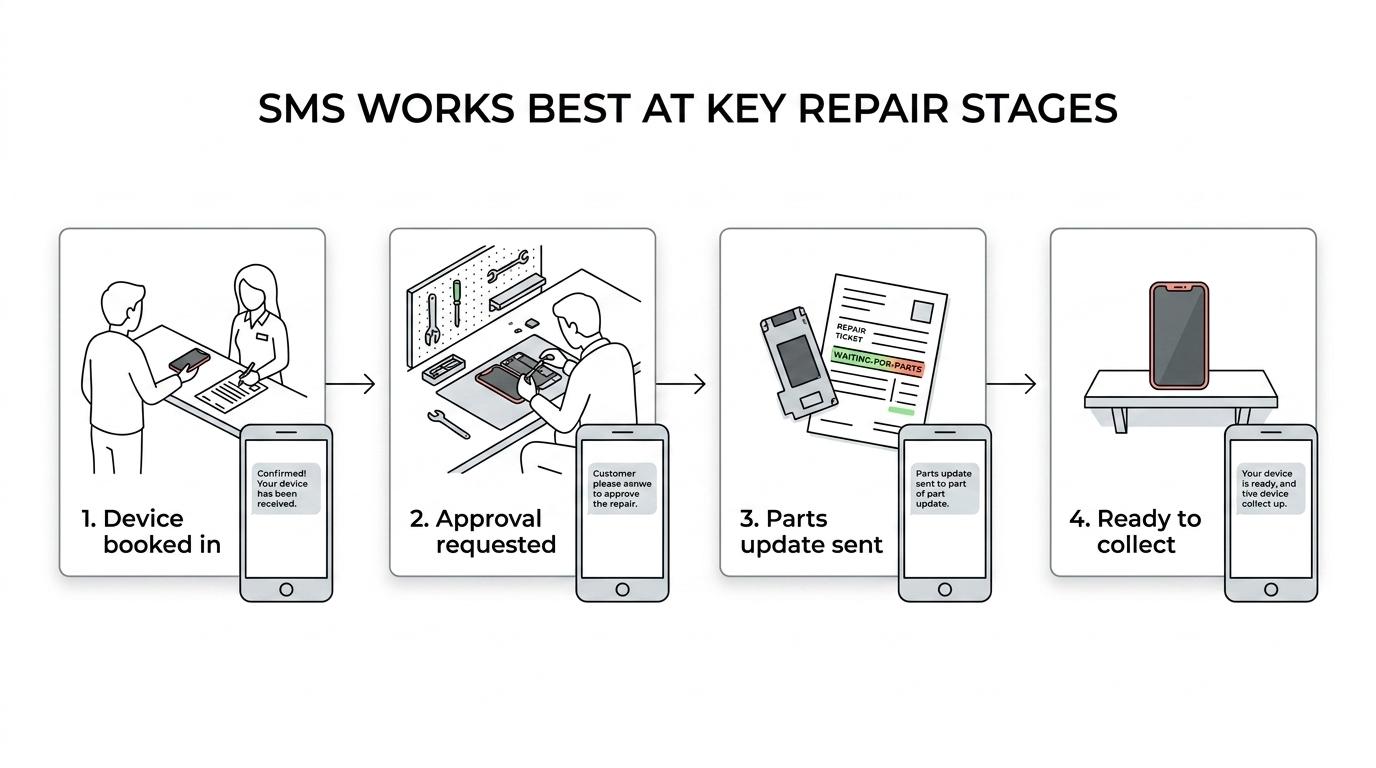
Start with intake. When the device is booked in, send confirmation that it has been received and logged. If the shop issues a ticket number, include it. This message lowers immediate anxiety and reduces “have you got my phone?” calls.
Next comes diagnosis and approval. If the original fault turns into a broader issue, the job should pause until the customer approves the new cost or scope. This is where SMS often saves the most time. If the customer does not reply within a set window, staff can escalate to a call.
Then use SMS for exceptions and completion. Parts delay, quality control pass, ready-for-collection and final collection reminder are all high-value triggers. A common mistake is texting every internal move, including technician assignment or bench transfer. Customers care about progress, approval and pickup, not every operational detail.
How does SMS notification software compare with WhatsApp for repair communication?
SMS wins on reach and urgency, while WhatsApp wins on richer conversation. Many repair shops use SMS for universal delivery and WhatsApp for photos, estimates or back-and-forth clarification.
SMS does not depend on app installation, data connectivity in the same way, or customer preference for a specific platform. That makes it reliable for appointment reminders, collection prompts and approval requests. It is especially useful when the only data you have is a mobile number.
WhatsApp is stronger when the customer needs to see something. A cracked frame, liquid damage indicator or replacement colour option is easier to explain with images. Shops that already use WhatsApp customer update tools often keep it for evidence and use SMS as the fail-safe channel for urgent nudges.
The trade-off is governance. WhatsApp workflows can become informal if they live on personal devices or unmanaged numbers. SMS inside the repair system is usually easier to standardise, log and report. If compliance and audit trail matter, integrated SMS often has the cleaner operating model.
How can you measure whether SMS reminders are reducing no-shows and delays?
The right way to measure SMS is by action metrics, not by open rates alone. Twilio’s general guidance fits repair shops well: track deliverability, replies, opt-outs and conversions against a clear baseline.
Step 1 is to define the business problem. Are you trying to cut missed appointments, speed up approval, reduce time-to-collection, or lower inbound status calls? Each goal needs its own measure. Without that, “SMS works” is only a feeling.
Step 2 is to compare before and after. Measure four to eight weeks of the current process, then measure the same period after SMS triggers go live. Look at average approval time, percentage of jobs collected within 48 hours of completion, number of missed bookings and number of status-chasing calls.
Step 3 is to review by trigger type. A ready-for-collection text may work brilliantly while a diagnosis-complete text gets poor reply rates because the wording is weak. If one template underperforms, rewrite it before changing the whole channel strategy.
What compliance and customer-consent rules matter for SMS in the UK?
UK repair shops need clear consent logic, accurate records and sensible message content. UK GDPR and PECR principles matter because service texts and marketing texts are not the same thing.
Transactional SMS about an active repair is usually easier to justify than promotional messaging, because it relates directly to the service the customer has asked for. That said, shops should still tell customers they will receive updates, record the mobile number correctly, and avoid mixing marketing into a service update unless consent covers it.
A frequent misunderstanding is that one tick box covers everything forever. It does not. If the message is a collection reminder for an active repair, that sits in a different category from a later promotion about accessories or upgrades. Keep those paths distinct in the system.
Message content matters too. Do not include more personal data than needed. Avoid unnecessary identifiers, and think about lock-screen visibility. A short status message is usually safer than a detailed diagnostic note.
How do you choose SMS notification software for a growing repair shop or chain?
The best SMS notification software for a repair business is integrated, measurable and easy to govern across counters or branches. ePOS4Mobiles is relevant here because it is built for mobile phone shops rather than generic retail.
Standalone SMS tools can send texts well, but they often struggle with repair context. If the system cannot see the ticket status, part usage, technician assignment or collection state, staff end up copying information manually. That weakens both speed and accuracy.
"ePOS4Mobiles has no per-user or setup fees, which matters when multiple counters, technicians and branches need access."
When comparing vendors, focus on operational fit rather than message volume alone.
- Repair workflow fit: Can SMS trigger from booking, diagnosis, approval, parts delay and collection states?
- Two-way handling: Can staff see replies against the right repair ticket instead of a separate inbox?
- Reporting: Can you track delivery, opt-outs, response timing and branch-level performance?
- Scaling model: Does the software support single shops and multi-location operations with real-time syncing?
- Commercial terms: Are there setup fees, per-user fees or channel restrictions that change cost as the team grows?
Can SMS notification software work with POS, stock and repair workflows in one system?
Yes, integrated systems connect SMS to POS, inventory and repair records more effectively than separate tools. In mobile retail, IMEI tracking, part stock and repair status often need to interact in real time.
Think about a battery replacement that becomes a parts-order case. If the repair system, stock control and customer messaging are linked, the customer can be notified when the part arrives without staff checking three separate tools. If the device is ready, the collection text can sit beside payment status and technician notes.
This matters even more for multi-site operations. A branch may book in the device, a central workshop may complete the repair, and another location may handle collection. If the platform syncs in real time, the SMS history follows the job rather than the person who happened to send the message.
For that reason, many repair businesses move away from standalone texting once repair volume grows. An integrated platform gives cleaner audit trail, better customer transparency and fewer handoff errors across the full life of the repair.